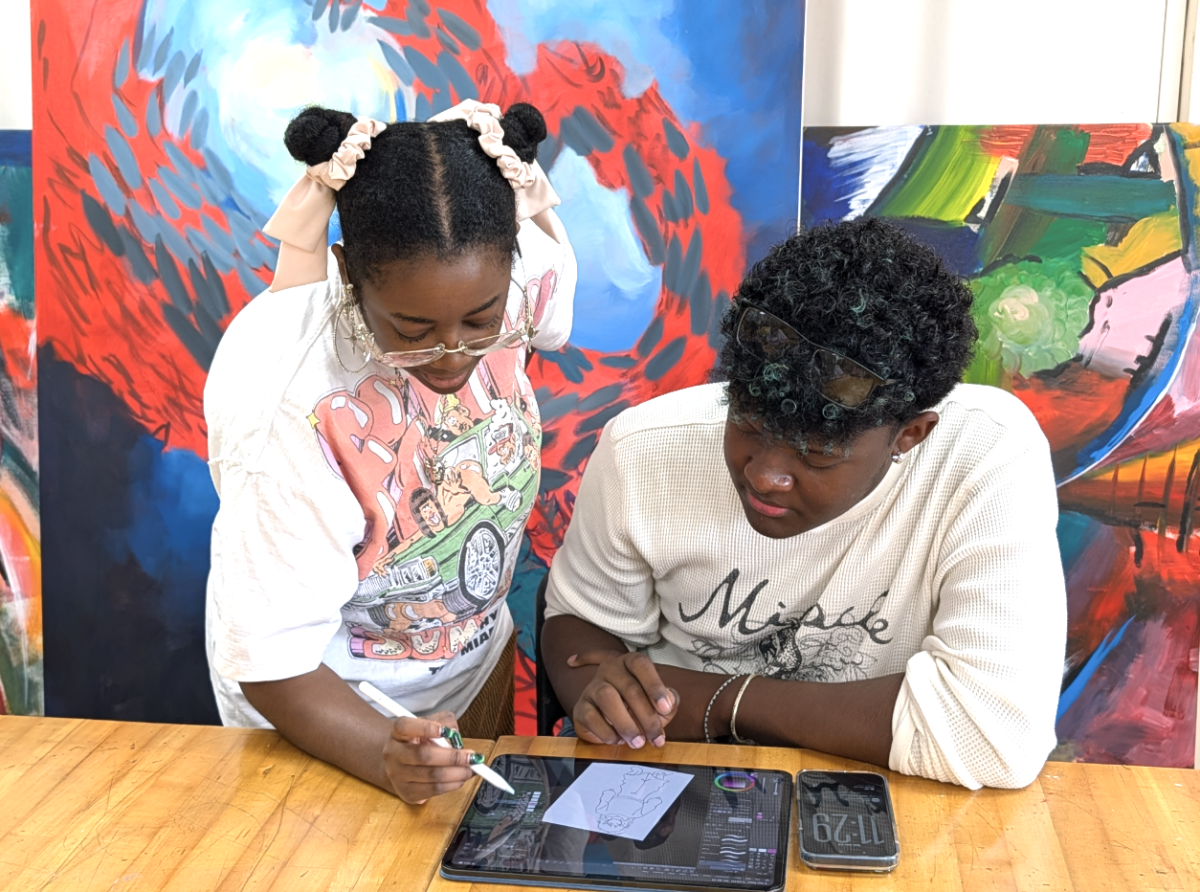
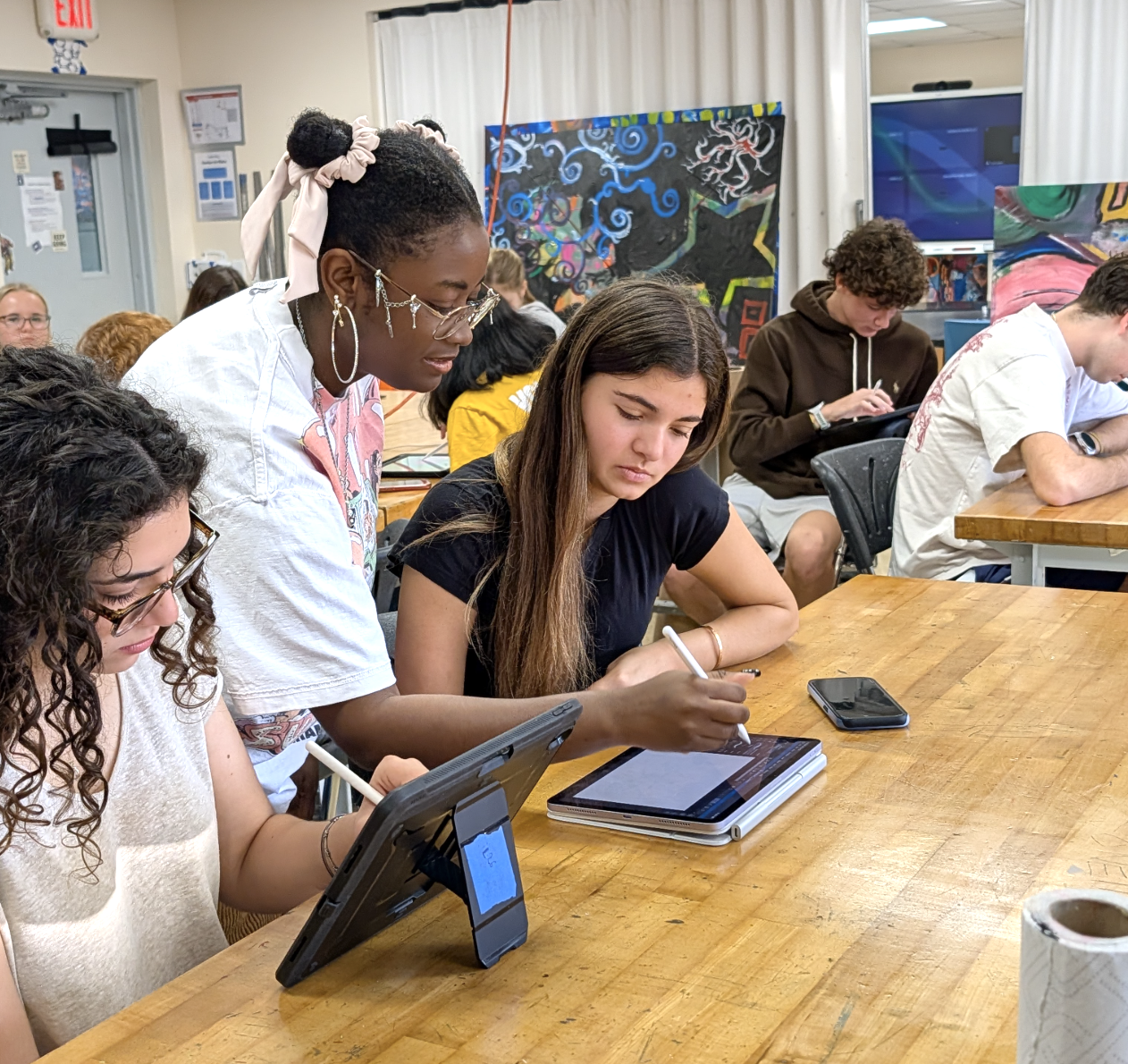
The usual clutter of materials and paintbrushes in the art room was replaced by screens and Apple pencils on Saturday, Jan. 24. Ruth Burotte, a Haitian-American multimedia illustrator, muralist, and motion designer, led the class, teaching a group of visual arts students the basics of digital art and design.
“For a lot of them, it was like their first time holding an Apple pencil and drawing on a tablet. I covered my process of how I approach character design and gave a presentation with tips to apply in art in their own artistic practices,” Burrote said. “Then it was a digital art workshop, I had them follow along and copy how I draw, so I was drawing but they had the liberty to add anything they wanted to the character that they were drawing.”
The four-hour in-depth digital art experience, hosted by the National Art Honor Society, welcomed 17 students to learn character design techniques, and how to draw, shade, and take advantage of the digital world of art. Many students had never even held an apple pencil, so Burrote gave an introduction to the medium and explained her approach to character design.
“It’s incredibly important for students to be exposed to contemporary artists who are actively working in the field,” art teacher Mrs. Toledo said. “Seeing how much Ruth has accomplished at such a young age and how deeply she engaged the students was truly inspiring, not just as an artist, but as a teacher.”
Aside from exposing students to a new medium, the workshop also gave them the opportunity to have their work shown, as Burotte will use each student’s character to create a cohesive art piece that will be donated to the school and sold at the Gala’s silent auction.
As the youngest artist in residence of Broward County to receive a commission from the Broward Public Art & Design program, Burrote has impacted her community significantly through visual arts.
“I’ve done a lot of community work like murals, collaborative work with youth for a juvenile facility, painting for live events, and brand collaborations,” artist Ruth Burrote said. “I usually just make art for the Miami community but I do a lot of stuff based on African-American and Caribbean characters since I myself am fully Haitian-American.”
Burotte’s multidisciplinary art spotlights bold, character-driven works that challenge archetypes and center around underrepresented voices, often Black and female.
“Most of the characters that I draw are black, sometimes Latino. It’s a mix of characters you don’t really see a lot or whenever they do, it’s not usually in the best light.”
Through urban and public works as well as immersive installations like “Rose Tinted Nostalgia For Life not Lived,” she uses humor and emotional depth to confront bias, mental health, and generational trauma, shaping Miami’s evolving creative landscape.
“Rose Tinted Nostalgia for Life not lived was an immersive installation where I had animations projected and mapped on full walls along with some artwork to support it,” Burrote said. “I made the exhibit because I wanted to invite audiences to question their authenticity with their memories and how much media can influence how you know yourself without you knowing.”
The workshop opened new doors for students who had experimented with digital art before but had never taken a class.
“I really enjoyed it, listening to her mentality about the art and learning many new techniques, because I feel like I always learn from traditional art teachers and getting her perspective on this was very interesting,” senior Sidney Dare said. “I’ve done digital art before but only experimenting on my own, I’ve never had a class or properly been taught, so learning her techniques made it feel less unattainable.”
Each student created their own character using the techniques and strategies that she uses to develop her art. The new perspective was especially enlightening to people who have experimented with digital art but have never been taught the specifics from an expert.
“She taught us how to color and shade, and it was interesting to hear about the way that she looks at people. She sees their clothing as shapes so that she can draw it as shapes and then later on make more details,” junior Naisha Cheruku said.