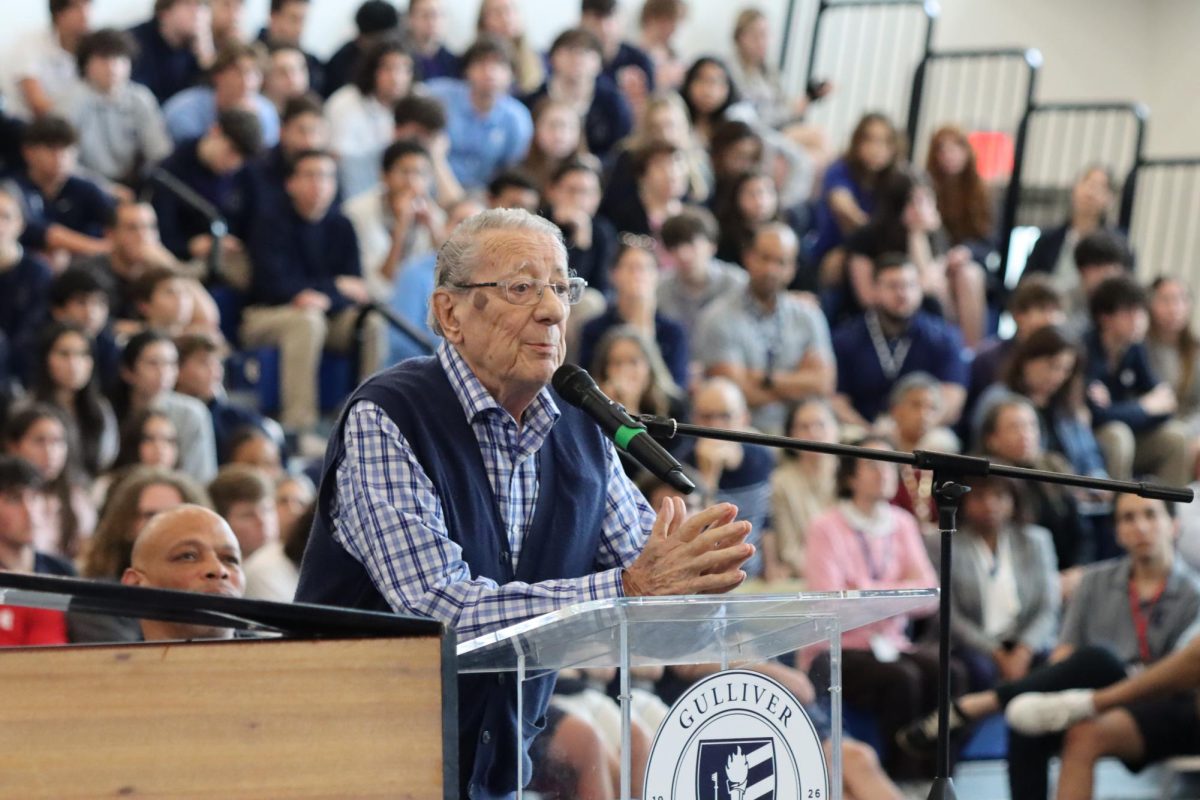
Ninety-six-year-old Holocaust survivor and musical conductor Peter Fuchs spoke to the Upper School community on Thursday, Jan. 22, sharing his survival story in honor of International Holocaust Remembrance Day.
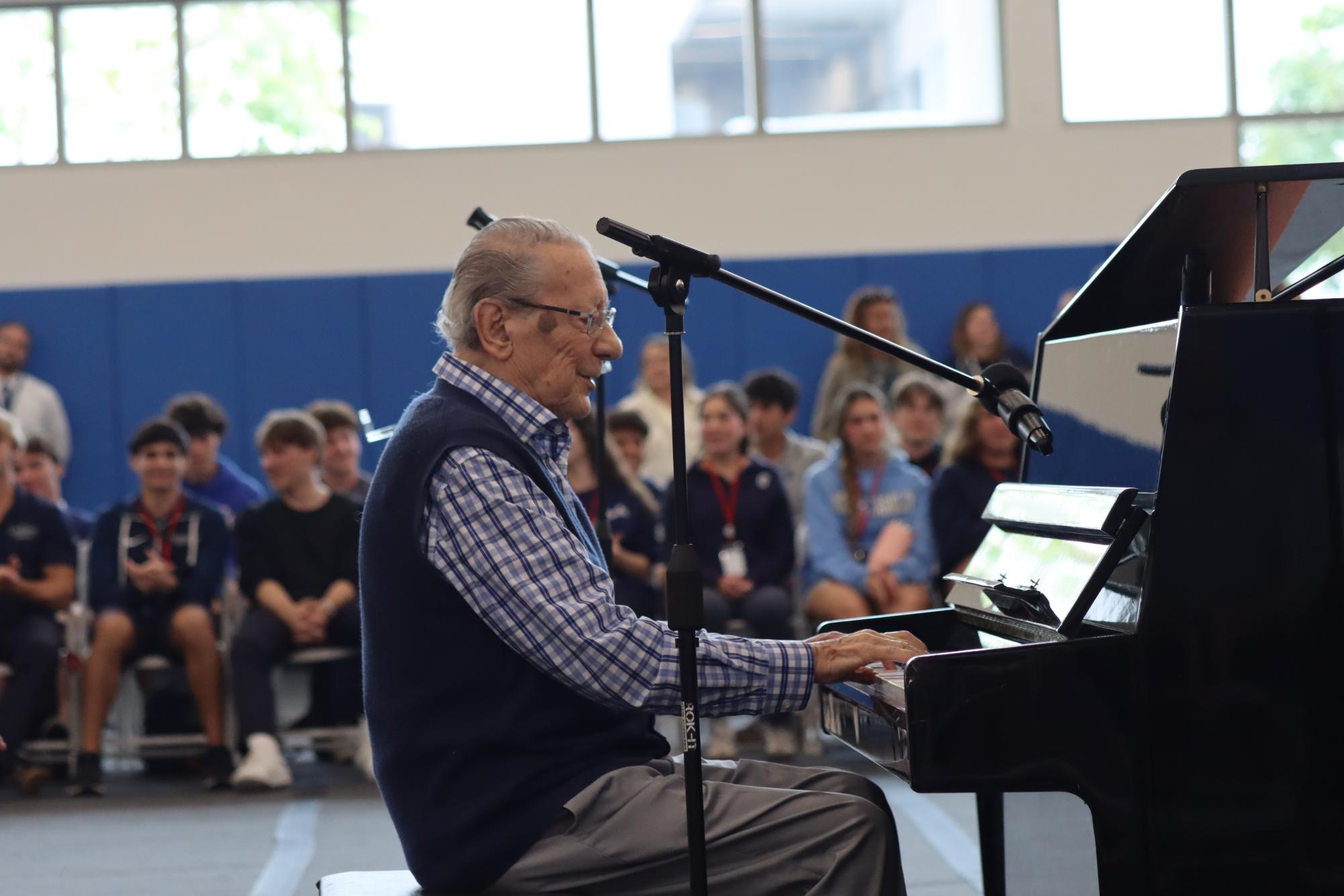
The assembly brought together students, faculty, and staff to hear Fuchs recount his experience as a child in Nazi-occupied Europe and how music later shaped a long career as a composer and conductor. He opened the assembly with a traditional Jewish tune, Oseh Shalom, meaning “peace be upon you” in Hebrew, on the piano.
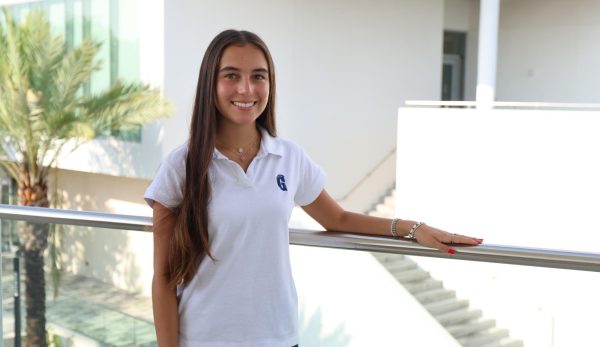
“This is not just an assembly or obligation; it is a gift to have Peter here with us to share his story, and we should all show our appreciation,” junior and Upper School Jewish Student Union co-president Carol Gandelman said.
Born in Düsseldorf, Germany in 1929 to a Jewish mother and Catholic father, Fuchs was raised Catholic; he was unaware of his Jewish identity as a young child. He was later sent to Holland to reunite with his mother and Jewish stepfather and was enrolled in an all-boys Catholic school to conceal his Jewish identity. Meanwhile, his family moved between hiding places all across Europe to avoid being caught and sent to a concentration camp.
“All we had to do was survive physically,” Fuchs said. “I didn’t have the chance to have [music] lessons, there was no such thing,” Fuchs said.
Despite this traumatic experience, Fuchs shared the impact music had on his life. During the war, he taught himself to play instruments after being given a banjo and later discovered the piano, a passion that would define his future.
“Music is what got me through life, and it has also made a very good profession for me,” Fuchs said.
After the war, Fuchs reunited with his parents and immigrated to the United States in 1947. He described sailing past the Statue of Liberty in New York City for the first time as a moment when there wasn’t a “dry eye” on anyone’s face.
Upper School Director of Community and Belonging Don Lawrence emphasized the importance of hearing stories like Fuchs’s directly from survivors.
“His life reminds us that the Holocaust is not an abstract chapter in a textbook,” Lawrence said. “His story reminds us that even in the face of unimaginable cruelty, creativity and humanity can survive.”
Fuchs closed the assembly by reminiscing on his post-war life, including a 65-year-old marriage, four children, and a lifelong musical career. He concluded his presentation by playing celebratory song Hava Nagila, meaning “Let us rejoice,” in Hebrew.